
If you’re targeting roles like Accounts Assistant, Bookkeeper, Assistant Accountant, or Practice Trainee, Xero is one of the most “hire-me now” skills you can add to your CV. It’s widely used by UK small and medium-sized businesses and accountancy practices, so being fluent in Xero signals that you can be effective from day one.
Why Xero skills are so employable
1) Built for UK compliance.
The UK’s Making Tax Digital (MTD) programme requires VAT-registered businesses to keep digital records and file through compatible software. MTD for VAT has applied to all VAT-registered businesses since April 2022. MTD for Income Tax Self Assessment is currently scheduled to start from April 2026 for self-employed/landlords with income over £50k, and April 2027 for those over £30k. Xero is HMRC-recognised for these workflows, which is exactly what practices and finance teams need help with.
2) Real-world processes, not just “clicks.”
Xero covers the full bookkeeping cycle—bank feeds and reconciliations, sales/purchase ledgers, journals, VAT returns, fixed assets, basic payroll connectivity, and management reporting. That means you can demonstrate end-to-end ownership of a month—precisely what hiring managers probe in interviews.
3) Ecosystem advantage.
Xero connects with hundreds of business apps (expense capture, e-commerce, reporting, inventory, billing). Showing you can plug Xero into tools like Dext, Shopify/A2X, or a reporting add-on instantly boosts your value to both practices and in-house roles.
What employers actually look for
-
Certification that proves competence.
Xero Advisor Certification is a recognised baseline. It’s free to study via Xero’s own learning portal and can be completed in a short, focused window (often within a day). Add the badge to your CV and LinkedIn. -
Hands-on evidence.
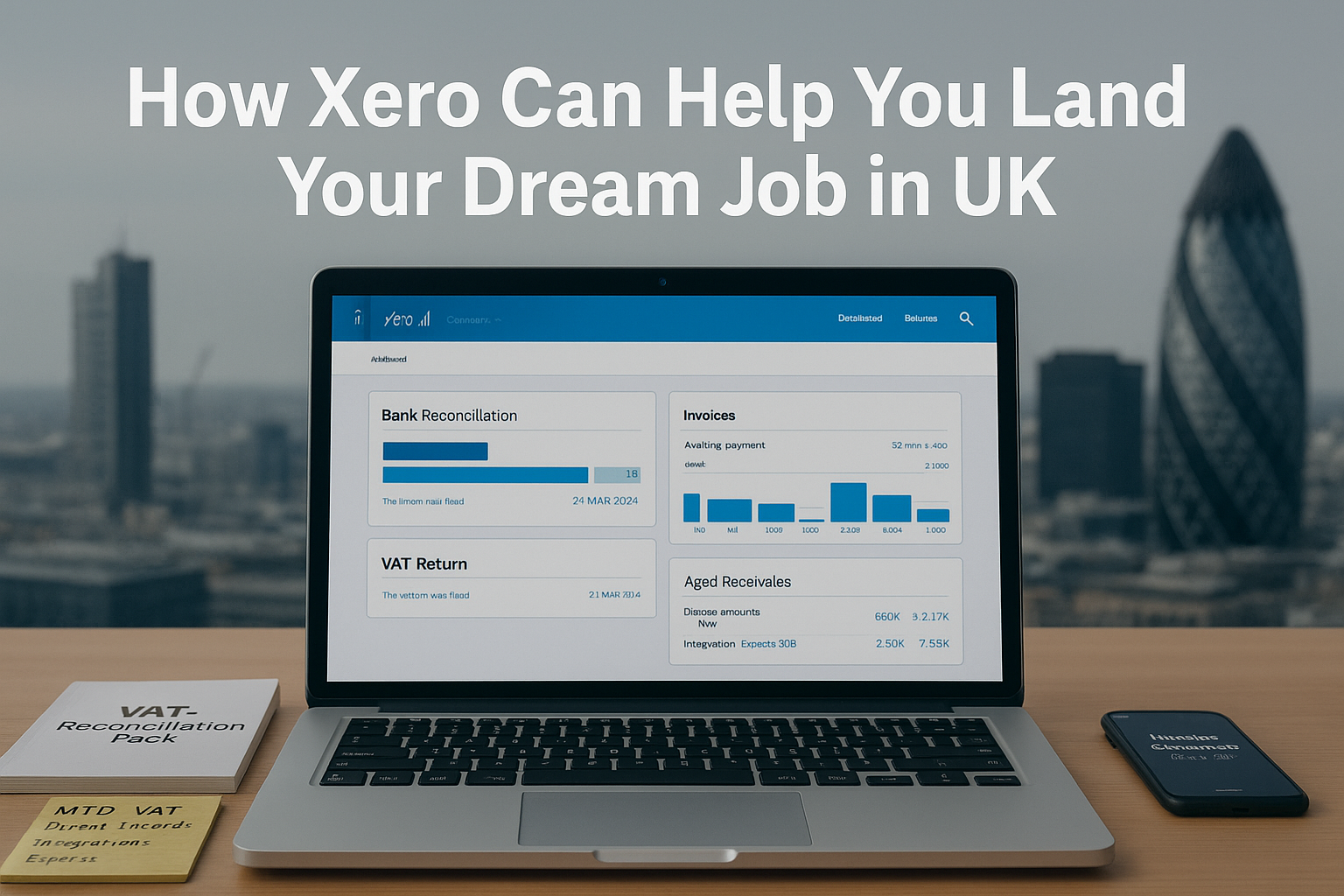
Most candidates say they “know Xero.” Few can show a tidy reconciliation, a clean aged debtors report, and a VAT return pack. Use Xero’s Demo Company to practice and export evidence (PDFs or screenshots) as a mini-portfolio. -
MTD-ready mindset.
Employers want people who understand digital record-keeping, audit trails, and quarterly VAT routines. Be ready to talk about how to prepare a VAT return in Xero, how you’d support clients through MTD ITSA, and how you’d maintain documentation. -
Data hygiene and controls.
Show you can prevent duplicates, post correcting journals, reconcile control accounts, and close a month systematically. That’s the difference between “software user” and “junior accountant.”
A 4-week plan to become “Xero-job-ready”
Week 1 – Foundations
-
Complete Xero’s core navigation, bank feeds, invoicing, bills, and reporting modules.
-
Make notes you can reuse in interviews (e.g., where to find bank reconciliation reports, how to post a repeating bill, how to lock a period).
Week 2 – Build a portfolio
-
In the Demo Company, do a full month: import a bank statement, reconcile to zero, process supplier bills and credit notes, chase overdue invoices, post an accrual and a prepayment, and run standard reports (P&L, Balance Sheet, Aged Receivables/Payables).
-
Export: reconciliation summary, aged reports, VAT return workings, and a brief “what I did” one-pager.
Week 3 – Add an integration
-
Pick one: Dext (OCR for bills), an e-commerce connector (e.g., Shopify/A2X), or a reporting tool.
-
Document the data flow: where transactions originate, how they land in Xero, how you reconcile payouts, and how you test completeness.
Week 4 – Interview prep + applications
-
Draft bullet points that quantify impact (see below).
-
Apply to roles that explicitly mention Xero and tailor your CV to mirror their language (bank recs, VAT, journals, app integrations).
CV bullets you can adapt
-
“Set up Xero bank feeds and completed month-end bank reconciliation with zero unreconciled items; reduced close time by two days.”
-
“Prepared MTD-compliant VAT workings and return in Xero; created a simple checklist to improve quarter-end accuracy.”
-
“Integrated Dext → Xero to automate payables capture; implemented supplier statement reconciliations and resolved historic duplicates.”
-
“Built a debtor-chasing routine from Xero’s aged receivables to cut 60-day balances; documented email templates and follow-up cadence.”
Interview talking points that impress
-
Controls: How you lock periods, use tracking categories, and reconcile control accounts (VAT, payroll, director’s loan).
-
Troubleshooting: Finding and fixing duplicates, suspense entries, and miscodings; using the History & Notes tab to evidence changes.
-
MTD knowledge: The April 2022 VAT requirement and the upcoming ITSA timeline, plus how Xero supports digital records and submissions.
-
Communication: How you’d explain a variance to a non-finance stakeholder using Xero’s reports and simple visuals.
Common mistakes to avoid
-
Only learning the clicks. Employers care about why, not just where to click. Tie every action to a control or outcome.
-
No proof of work. Without a portfolio, your “I know Xero” claim sounds like everyone else’s.
-
Ignoring integrations. Even one integration case study separates you from the pack.
-
Forgetting basics. Bank recs, tidy ledgers, and clear VAT evidence beat flashy dashboards in most junior interviews.
Conclusion
Xero is more than a software line on your CV—it’s a fast track to showing you can run the UK bookkeeping cycle to a professional standard, support MTD obligations, and plug into a modern finance stack. Get certified, build a demo-based portfolio, add one real integration, and apply with clear evidence. Do that, and you won’t just meet job specs—you’ll stand out as the person who can deliver from week one.